





Case study · Government-scale delivery
Automation at scale: most programmes never get past the first pilot.
We put 146 processes into production in twelve months.
Across twenty-five separate organisations, no two of them alike. Different systems, different approval chains, different limits on what software is allowed to decide. One deadline that could not move, and no second attempt.
The programme returns 160,000 hours a year to the people who used to do that work by hand.
We don’t stop at pilots. We deliver automation at scale that keeps running after we leave.
What we delivered
146
processes into production
12
months, start to finish
25
organisations, none alike
What the programme delivered
240
processes in total
160,000
hours a year returned
1.8M
people served
The record
Six of them, on film
We made six films with five of these organisations, so you can watch the work instead of taking our word for it. They are grouped by the kind of work rather than by the institution, because the work is what repeats in your business.
Documents assembled from data that lives in three places
The quote, the contract, the invoice, the HR letter. The content is already correct in your systems. A person is just putting it together, and that person is the bottleneck.
MEDAT
Ministry of Economy, Digitalization, Entrepreneurship and Tourism
Eighty administrative orders a month, drafted the same working day
Eight types of order, each with its own legal basis and its own structure, written from scratch by a team of ten. The data came from the personnel file and the payroll spreadsheet, gathered by hand every time.
The specialist picks the order type and fills the fields. The robot reads the employee’s last order, pulls salary and allowances from the payroll file, applies the rules for that type, and produces both the order and its approval memo in the organisation’s own format.
MMAP
Ministry of Environment, Water and Forests
Thirty-nine workflows, from asset registers to professional licensing
Data copied field by field out of legal decisions and into the national finance system. Licensing files checked page by page. Registration numbers assigned by hand, so applicants waited their turn.
One robot reads the decisions and enters each asset with no field typed by hand. Another registers licensing applications, checks the documents, validates length of service and notifies the committee. The registry assigns and sends reference numbers on the hour, every working day.
Recognise this in your own back office?
Reconciliation between systems that do not talk to each other
Month-end close, AP matching, and every report that begins life as an email with a spreadsheet attached.
MIPE
Ministry of Investments and European Projects
Weekly reconciliation of funding claims
Seven separate bodies each send a spreadsheet of claims every week. Two people opened every file, looked up each claim in the source system and compared the dates by hand. Whenever a file arrived in the wrong format, the errors surfaced days later.
A dispatcher robot validates the file structure on arrival and tells the sender immediately when it is wrong. Each claim then becomes its own transaction: the robot opens its history in the source system, compares the reported dates, and flags every discrepancy.
SGG
General Secretariat of the Government
A national inventory, automated from day one
Nobody knew which applications, systems and licences the public sector actually runs. Compiling it by hand would have meant chasing hundreds of organisations one at a time, in whatever format each chose to answer in.
They built the mechanism as an automation from the start. Each month the robot pulls the procurement report, filters by code and value, writes to every eligible organisation with a standard form attached, and consolidates the answers into one file. Every request it sends is logged and auditable.
Not sure whether yours is automatable?
We can tell you in one call.
The inbox: requests that arrive as email and have to be answered
Customer service, supplier onboarding, and every queue where someone reads, looks something up, and writes back.
MIPE
Ministry of Investments and European Projects
Three robots on the requests desk
Roughly an hour per request: find it, look it up, draft the reply, log it. The recurring reports were compiled by hand, and chasing applicants for missing data was somebody’s standing job.
The first robot checks the inbox every thirty minutes, recognises the request type, validates the reference number and drafts the reply. The team reviews and signs; the robot sends. The second emails reporting to twenty departments, three times a month, at four in the morning. The third chases missing data on its own and updates the central tracker.
ADR
Authority for the Digitalization of Romania
The programme owner automated its own back office first
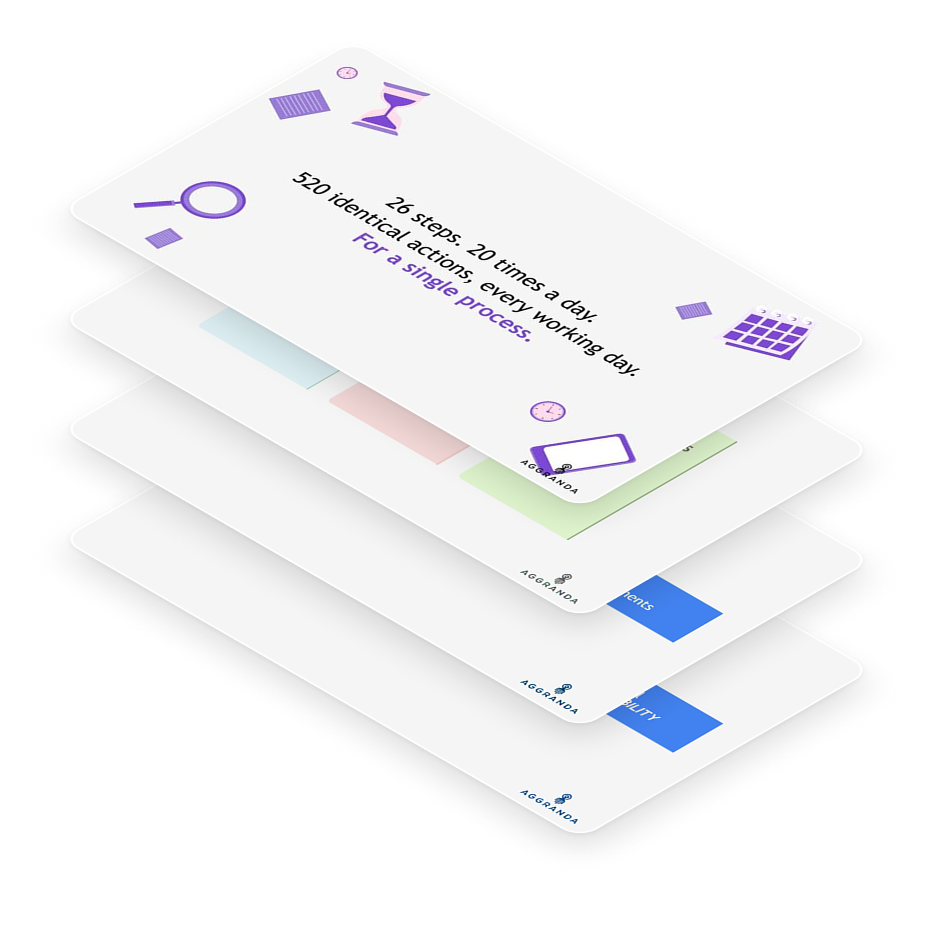
One routine ran to twenty-six steps and was repeated twenty times a day: open the sheet, copy the address, raise the ticket, copy the reference back, colour the row. Website compliance was a tick in a table, with nothing to show for it afterwards.
The robot does the full sequence, every time, identically. A second one visits public websites, tests nine accessibility criteria and screenshots each result with a timestamp, turning that tick into an evidence file. Legal interpretation stays with people: the robot gathers what they need in order to decide.
Who we work with
You are in good hands.
Over eight years, we have built automations for companies and institutions across the United States and Europe, in finance, retail, telecom, logistics and the public sector. Today, Aggranda is a UiPath Diamond Partner. See more of our Intelligent Automation Case Studies.
United States




Europe







Talk to us
Send us one process.
The one everybody complains about and nobody has had time to fix. Tell us roughly how it runs today, and we will tell you what it would take to automate it.
We will also tell you when it is not worth automating. Some processes are not, and you should hear that before you spend anything.
A person reads it, and replies within one working day.

Diamond UiPath Partner