



Databricks NetSuite Performance: 35x Faster Data Pipeline (10 Hours to 17 Minutes)

17

1
This Databricks NetSuite performance use case shows how a large retail enterprise reduced an Oracle NetSuite ERP data pipeline from 10 hours to around 17 minutes using Databricks.
In enterprise retail, millions of ERP transactions move every single day. Orders, stock movements, financial postings, and operational updates constantly generate new data that needs to be processed quickly and reliably.
When the data platform cannot keep up, dashboards lag, teams wait, and decisions are made on yesterday’s numbers. That was the challenge in this Oracle NetSuite ERP environment before the Databricks redesign.
The Client Context
A large retail enterprise running Oracle NetSuite ERP was processing millions of transactions daily across critical business flows. The organization depended on its data platform for visibility into operational and financial performance, but the existing architecture was too slow to support the pace of the business.
The full pipeline ran overnight, from 9 PM to 5 AM, taking approximately 10 hours to complete. It could run only once per day. If anything failed, reporting was delayed by 24 hours, reducing operational visibility and slowing down decision-making across teams.
This Databricks NetSuite performance challenge was not just about speed. It affected reliability, reporting agility, and the organization’s ability to act on fresh data.
The Challenge
The initial architecture created several business and technical constraints.
The overnight batch window was too long and too rigid. The pipeline had only one execution per day, which meant there was no practical way to refresh reporting during business hours. Any failure had a direct operational impact and created a full day of delay for dependent teams.
The main issues included:
Long overnight batch window
Single daily refresh
High operational dependency on successful batch execution
Limited reporting agility
Slow access to operational data
Delayed visibility for business teams
For a retail business operating at scale, this type of dependency creates friction across the organization. Teams lose time, reporting becomes stale, and the business reacts too late.
Our Approach
To solve the Databricks NetSuite performance issue, Aggranda redesigned the architecture using the Databricks platform as the central data processing layer.
The solution included JDBC-based ingestion from Oracle NetSuite, custom libraries, optimized data processing, production-grade orchestration, monitoring, and failure alerts. The environment was designed for reliability, scalability, and measurable runtime performance in production.
Key implementation elements included:
JDBC-based ingestion from Oracle NetSuite
Custom libraries for the Databricks environment
Optimized data processing flows
Production-grade orchestration and dependency handling
Monitoring and failure alerts
Enterprise scheduling with controlled refresh intervals
This Databricks NetSuite performance architecture was built to do more than improve technical metrics. It was designed to support the business with faster, more reliable access to operational data.
Architecture and Pipeline Performance
At the core of this Databricks NetSuite performance use case is a fully orchestrated production pipeline.
Instead of relying on a long overnight process with limited flexibility, the new architecture supports controlled, repeatable execution with monitoring and alerting built in. This improves both runtime performance and operational resilience.
The pipeline processes NetSuite data in Databricks through an optimized configuration that reduces runtime dramatically while maintaining production reliability. The result is a faster and more scalable enterprise data platform.
This is also where Databricks proves its value beyond analytics. It becomes a performance layer for enterprise data engineering, enabling high-frequency refresh cycles and better reporting responsiveness.
Results
The results of this Databricks NetSuite performance implementation were clear and measurable.
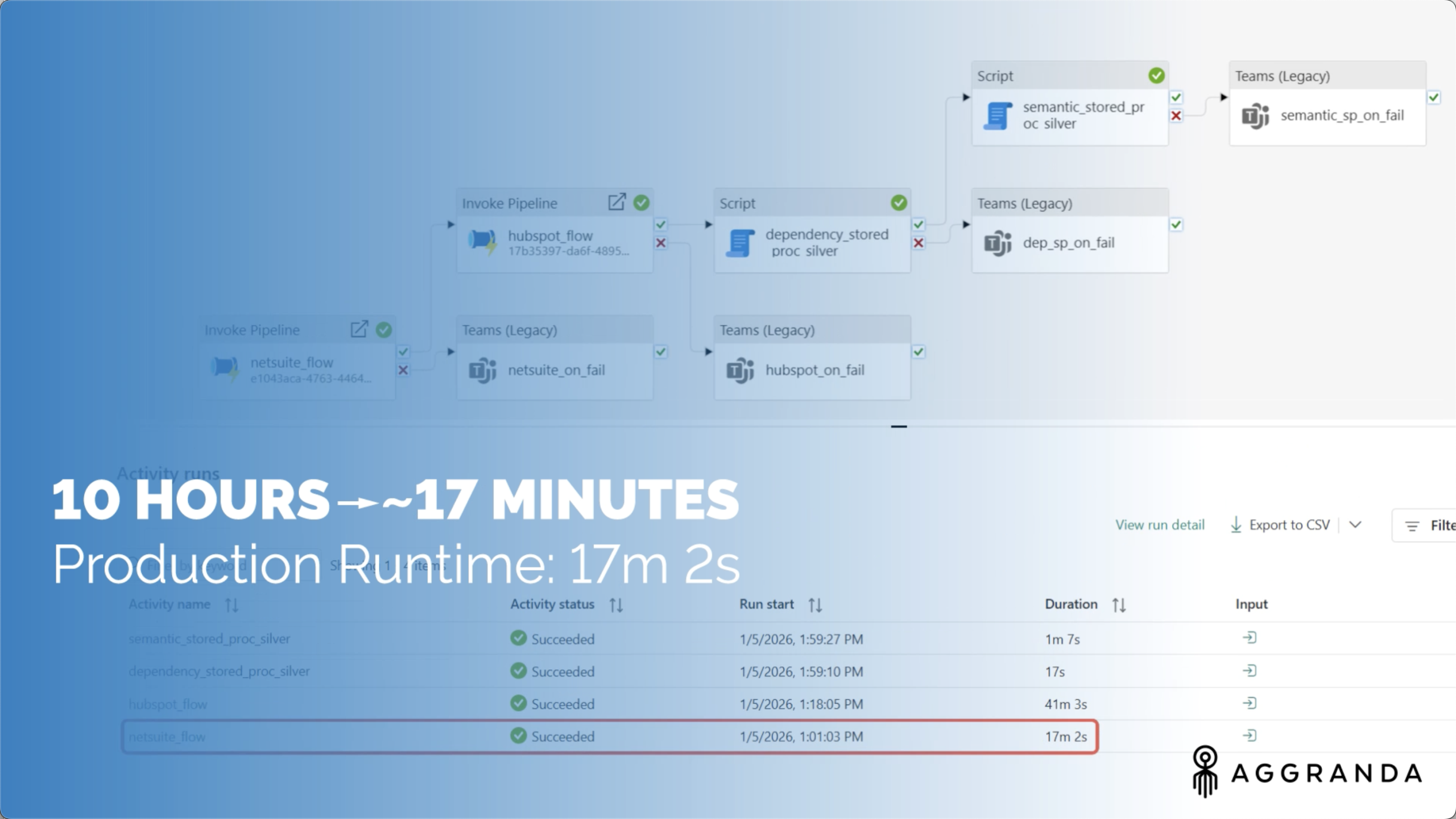
Production pipeline runtime reduced from 10 hours to approximately 17 minutes using Databricks
This screenshot shows the production runtime of the NetSuite pipeline running in Databricks, reduced to approximately 17 minutes end-to-end.
Runtime was reduced from approximately 10 hours to about 17 minutes. The production runtime was validated at 17m 2s end-to-end. Instead of running once per day, the pipeline is now scheduled to refresh every 60 minutes during business days.
Key outcomes included:
Runtime reduced from 10 hours to approximately 17 minutes
More than 35x performance improvement
Production runtime validated at 17m 2s
Automated hourly refresh during business days
Near real-time operational visibility
Improved resilience through monitoring and failure handling
This Databricks NetSuite performance improvement changed the operating model completely. What was previously an overnight dependency became a much more responsive and scalable data pipeline.
Impact
The organization moved from a single overnight batch process to an orchestrated Databricks environment capable of supporting faster business decisions and more accurate reporting.
Instead of waiting until the next morning for refreshed data, teams now benefit from hourly refreshes during business days. This significantly improves visibility into operations and reduces the business risk associated with stale data.
The impact was not theoretical. This implementation is fully running in production and represents a measurable transformation in enterprise data platform performance.
Why This Matters
Many enterprise data platforms are still designed around overnight batches and limited refresh windows. That approach may have worked in the past, but it is no longer enough for organizations that need faster decisions and more responsive reporting.
This Databricks NetSuite performance use case shows how modern data engineering can remove bottlenecks, reduce runtime dramatically, and improve the reliability of business-critical reporting flows.
For retail organizations running ERP-heavy environments, performance is not just a technical issue. It directly affects how quickly the business can see, decide, and act.
Technical Stack
- Oracle NetSuite ERP as the source operational system
- Databricks for data processing and orchestration
- JDBC-based ingestion from NetSuite
- Custom libraries and optimized runtime configuration
- Production monitoring and failure alerts
- Hourly refresh scheduling during business days
Related Use Case
Databricks can also be used not only to improve runtime performance, but also to push insights back into operational systems. Explore our Databricks retail use case for ERP write-back.
About Aggranda
Aggranda helps enterprise organizations transform complex processes into scalable, intelligent workflows using automation, data engineering, and AI.
With over 1 million hours of manual work saved for clients, Aggranda delivers real business impact through production-ready enterprise solutions.